
How Hearing Aids Work
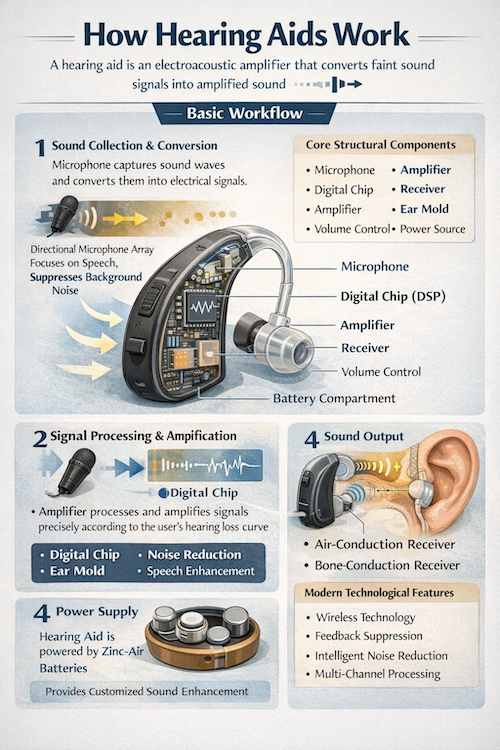
A hearing aid is an electroacoustic amplifier. Its core operating principle involves an “acoustic-electrical-acoustic” energy conversion process, where faint sound signals are amplified and then transmitted into the ear to help individuals with hearing loss improve their auditory function . Basic Workflow The operation of a hearing aid can be divided into four main stages: 1.Sound Collection and Conversion: The microphone picks up sound waves from the environment and converts sound energy into weak electrical signals. Modern hearing aids often use directional microphone arrays, which intelligently focus on sound sources in front of the user and suppress background noise . 2.Signal Processing and Amplification: The amplifier receives the electrical signals from the microphone and selectively amplifies them based on the user’s hearing loss curve. A digital chip performs spectral analysis of the sound, distinguishes between speech and environmental noise, and provides precise compensation for different frequencies. Modern hearing aids employ non-linear amplification technology to achieve the effect of “amplifying soft sounds more and loud sounds less” . For instance, hearing aids like the G22, G29, and G31 utilize digital chips to ensure highly personalized sound processing, intelligent environmental adaptation, and a clear, comfortable listening experience. 3.Sound Output: The receiver (speaker) converts the processed electrical signals back into sound waves, transmitting them into the ear canal either via air conduction or bone conduction. An air-conduction receiver directs sound waves into the ear canal, while a bone-conduction receiver directly stimulates the inner ear through skull vibrations . 4.Power Supply: Hearing aids are powered by zinc-air batteries (button cells). The battery capacity is proportional to the hearing aid’s gain and output power . Core Structural Components A hearing aid consists of six basic components: a microphone, an amplifier, a receiver, an ear mold (ear tip), a volume control switch, and a power source . Additionally, most hearing aids are equipped with auxiliary circuits such as tone controls, induction coils, and output limiting controls . Modern Technological Features Modern digital hearing aids have evolved from simple amplifiers into intelligent auditory systems . They feature multi-channel processing, intelligent noise reduction, feedback suppression, and wireless connectivity . Through professional fitting, hearing aids can be personalized according to the type and degree of the user’s hearing loss, with errors controllable within ±3dB
Post time: 一-13-2026