
Hearing loss affects communication, social interaction, and daily life quality for millions of people worldwide. With the continuous development of hearing assistance technology, digital hearing aids have become the preferred choice for modern users due to their intelligent processing capabilities, comfortable wearing experience, and personalized sound adjustment features.
Unlike traditional analog hearing aids that simply amplify all sounds, digital hearing aids use advanced digital signal processing technology and intelligent chips to analyze, optimize, and adjust sound signals in real time. This allows users to enjoy clearer speech, reduced background noise, and a more natural listening experience in different environments.
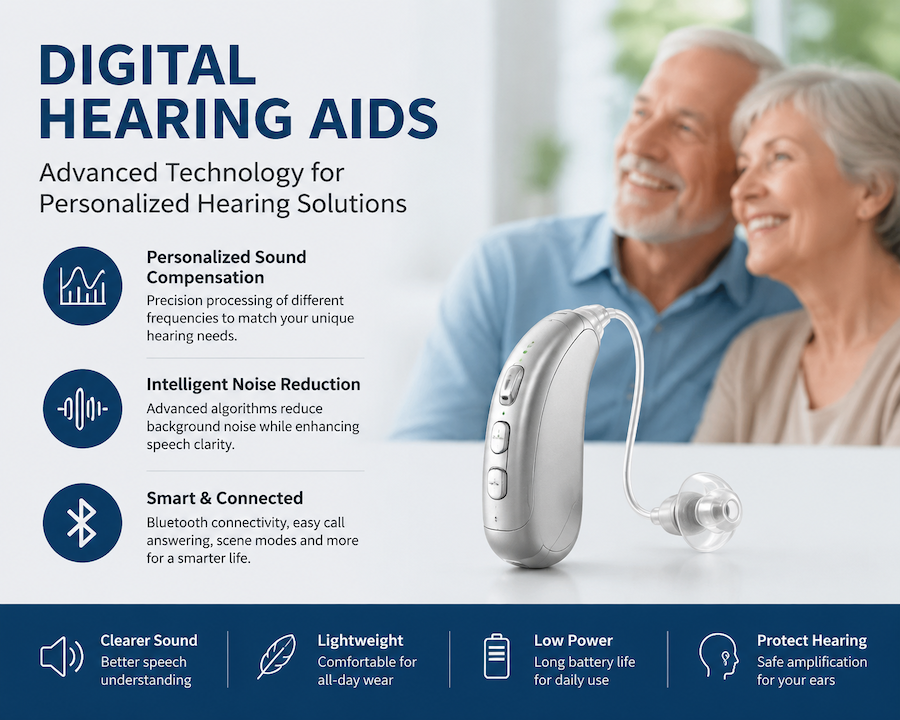
What Are Digital Hearing Aids?
Digital hearing aids are advanced hearing devices that convert sound signals into digital data through built-in processors. After receiving external sounds, the device analyzes different frequencies, identifies speech signals, reduces unnecessary noise, and adjusts output according to the user’s hearing condition.
The core technology behind digital hearing aids is the DSP (Digital Signal Processing) chip. This intelligent processor enables accurate sound adjustment, making hearing compensation more precise and personalized compared with traditional hearing devices.
For users with different levels of hearing loss, digital hearing aids provide customized solutions based on professional hearing tests and audiometric data, helping improve hearing clarity while maintaining comfort during long-term use.
Personalized Sound Adjustment for Different Hearing Needs
One of the biggest advantages of digital hearing aids is their ability to provide personalized sound compensation.
Traditional hearing aids usually apply the same amplification method to all sounds, which can result in uncomfortable experiences such as overly loud background noise or unclear speech. Digital hearing aids solve this problem through advanced frequency processing technology.
By analyzing the user’s hearing loss characteristics, digital hearing aids can adjust different frequency ranges separately. Weak speech frequencies can receive appropriate amplification, while overly strong sounds can be automatically controlled.
This intelligent adjustment helps achieve a balanced hearing experience:
- Enhance unclear speech sounds
- Reduce unnecessary sound amplification
- Maintain natural listening comfort
- Protect remaining hearing ability
Every person’s hearing condition is different. Therefore, personalized adjustment is essential for achieving better hearing results. Digital hearing aids allow professional audiologists to fine-tune settings according to individual needs, providing a more accurate hearing solution.
Intelligent Noise Reduction for Clearer Speech
In daily life, users often face challenging listening environments, such as restaurants, shopping malls, offices, and outdoor areas. Background noise can make conversations difficult, especially for people with hearing loss.
Modern digital hearing aids are equipped with intelligent noise reduction algorithms and environmental recognition technology. These systems can analyze surrounding sounds and distinguish between speech signals and unwanted noise.
For example, when users are in a crowded restaurant, the device can focus on human voices while reducing surrounding conversations and background sounds. When walking on a busy street, it can automatically adjust processing strategies to improve speech clarity.
Another important feature is feedback cancellation technology. Traditional hearing aids may produce unpleasant whistling sounds during use, but digital hearing aids can detect and eliminate feedback signals quickly, improving wearing comfort.
With intelligent sound processing, users can enjoy:
- Clearer conversations
- Reduced background interference
- More natural sound quality
- Better communication efficiency
Smart Features Improve Everyday Convenience
Beyond basic hearing compensation, digital hearing aids now include various smart functions designed for modern lifestyles.
Many advanced models support Bluetooth connectivity, allowing users to connect directly with smartphones, televisions, tablets, and other digital devices. Audio signals can be transmitted wirelessly, creating a more convenient entertainment and communication experience.
For example, users can:
- Answer phone calls directly through hearing aids
- Stream music from mobile devices
- Watch TV with clearer audio
- Adjust hearing settings through mobile applications
In addition, intelligent scene recognition technology allows hearing aids to automatically switch between different modes according to the surrounding environment.
Whether users are:
- Having a conversation at home
- Working in an office
- Traveling outdoors
- Participating in social activities
Digital hearing aids can provide suitable sound adjustment without requiring frequent manual operation.
Lightweight Design and Comfortable Wearing Experience
Comfort is another important factor when choosing hearing assistance devices. Modern digital hearing aids focus not only on performance but also on user experience.
Many devices feature compact designs with lightweight materials, making them comfortable for extended daily wearing. The wireless structure eliminates complicated cables and allows users to integrate hearing assistance technology naturally into their lifestyle.
A well-designed digital hearing aid should provide:
- Comfortable long-term wearing
- Easy operation
- Reliable performance
- Discreet appearance
These improvements make hearing aids no longer just medical devices but also intelligent lifestyle products that help users stay connected with the world.
Why Choose Digital Hearing Aids?
Compared with traditional hearing devices, digital hearing aids provide significant improvements in sound processing, comfort, and intelligent functions.
The main benefits include:
1. More Accurate Hearing Compensation
Digital processing technology allows precise adjustment based on individual hearing conditions.
2. Better Noise Control
Advanced algorithms reduce unwanted noise and improve speech understanding.
3. Stronger Connectivity
Bluetooth and smart functions make communication and entertainment more convenient.
4. Personalized User Experience
Different hearing programs can meet various environments and lifestyle needs.
With continuous innovation in artificial intelligence, wireless communication, and acoustic technology, digital hearing aids will continue to become smarter and more user-friendly.
Conclusion
Digital hearing aids represent the future direction of hearing assistance technology. Through intelligent sound processing, personalized adjustment, noise reduction algorithms, and wireless connectivity, they provide users with clearer sound, better communication, and a more comfortable daily experience.
For people looking for a modern hearing solution, choosing a high-quality digital hearing aid can significantly improve listening comfort and overall quality of life. As technology continues to advance, digital hearing aids will offer even more intelligent and personalized hearing support for users worldwide.
Post time: 七-27-2026