
Choosing the right hearing aid is essential for improving speech clarity, listening comfort, and everyday communication. However, with various hearing aid types available on the market, many people find it difficult to determine which device best matches their hearing needs. Different designs offer different levels of sound amplification, noise reduction, comfort, and appearance.
Understanding the differences between Behind-the-Ear (BTE), In-the-Ear (ITE), Completely-in-Canal (CIC), and Receiver-in-Canal (RIC) hearing aids can help users make more informed decisions. Each type has its own advantages and limitations, making professional hearing assessments and personalized fitting important parts of the selection process.
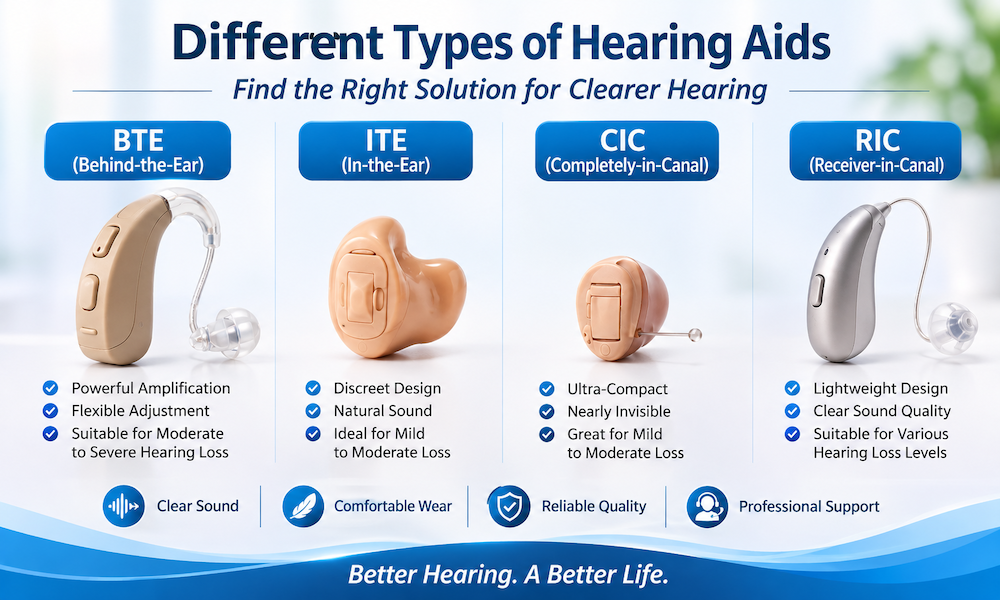
1. Behind-the-Ear (BTE) Hearing Aids: Powerful Amplification for Different Needs
Behind-the-Ear hearing aids are among the most established and widely used hearing device designs. Their main electronic components are housed in a durable casing positioned behind the ear, while sound is delivered into the ear through a tube or earmold.
One of the main advantages of BTE hearing aids is their ability to provide relatively strong sound amplification. Their larger housing also provides more space for batteries, controls, and digital sound processing components.
Key Features of BTE Hearing Aids:
- Strong amplification suitable for moderate to profound hearing loss, depending on the model.
- Flexible sound adjustment and programming options.
- Durable construction for everyday use.
- Larger controls that can be easier for some older adults to operate.
- Multiple earmold and fitting options.
BTE devices are particularly suitable for users who require higher amplification levels or prefer a more traditional hearing aid design.
However, their relatively visible appearance may not appeal to users who prioritize discreet styling. Their performance in noisy environments also depends on the model’s directional microphones and noise management features.
2. In-the-Ear (ITE) and Completely-in-Canal (CIC) Hearing Aids: Discreet and Compact Designs
In-the-Ear and Completely-in-Canal hearing aids are designed to fit inside the outer ear or ear canal. Unlike BTE models, these devices integrate their electronic components into a compact custom-molded shell.
Their smaller appearance makes them attractive to users who prefer hearing aids that are less noticeable during everyday activities.
Main Advantages of ITE and CIC Hearing Aids:
- Compact design with a discreet appearance.
- Custom fitting based on individual ear anatomy.
- Convenient for daily communication.
- Less exposure to wind noise in certain situations.
- Natural use of the outer ear’s acoustic characteristics, depending on the design.
ITE hearing aids generally offer more space for controls and batteries than CIC models. CIC devices, meanwhile, are positioned deeper inside the ear canal and provide a more concealed appearance.
Nevertheless, smaller devices have certain limitations. CIC hearing aids may have shorter battery life, smaller controls, and less available space for advanced features. Their suitability also depends on ear canal anatomy, hearing loss severity, and individual dexterity.
These devices are commonly considered for people with mild to moderate hearing loss, although some ITE models support greater amplification.
3. Receiver-in-Canal (RIC) Hearing Aids: Balancing Comfort and Sound Quality
Receiver-in-Canal hearing aids have become a popular option because they combine a relatively discreet appearance with flexible sound performance.
Unlike traditional BTE devices, RIC hearing aids place the receiver directly inside the ear canal, connecting it to the main body through a thin wire. This configuration separates the microphone and processing components from the receiver.
Why Consider RIC Hearing Aids?
- Lightweight design for comfortable everyday wearing.
- Relatively discreet appearance behind the ear.
- Flexible amplification options for different hearing needs.
- Open-fit configurations available for suitable users.
- Advanced models may include directional microphones and digital noise management.
RIC devices can provide a comfortable listening experience while maintaining good speech clarity. Their receiver configuration also allows different receiver power levels to be selected according to individual requirements.
Compared with some traditional BTE models, RIC hearing aids have a more streamlined design. However, their performance depends on the specific receiver, fitting configuration, and digital processing technology.
RIC models are available for a wide range of hearing loss levels, from mild to severe, with selected models supporting more significant hearing impairment.
4. BTE vs ITE vs CIC vs RIC: What Are the Main Differences?
Although these hearing aid types share the same basic purpose, their structural designs influence amplification capacity, appearance, comfort, and maintenance requirements.
The following comparison provides an overview of their main characteristics.
| Comparison | BTE | ITE | CIC | RIC |
|---|---|---|---|---|
| Wearing Position | Behind the ear | Outer ear | Deep ear canal | Behind ear with receiver in canal |
| Appearance | More visible | Relatively discreet | Highly discreet | Relatively discreet |
| Amplification | Medium to very high | Low to high | Usually low to moderate | Low to high |
| Comfort | Model-dependent | Custom fitted | Custom fitted | Lightweight design |
| Controls | Generally larger | Model-dependent | Usually smaller | Model-dependent |
| Maintenance | Moderate | Regular cleaning | Regular cleaning | Receiver and earwax maintenance |
| Suitable Users | Various hearing loss levels | Mainly mild to severe | Mainly mild to moderate | Various hearing loss levels |
Note: These are general comparisons. Actual amplification, available features, and suitability vary by manufacturer and individual device model.
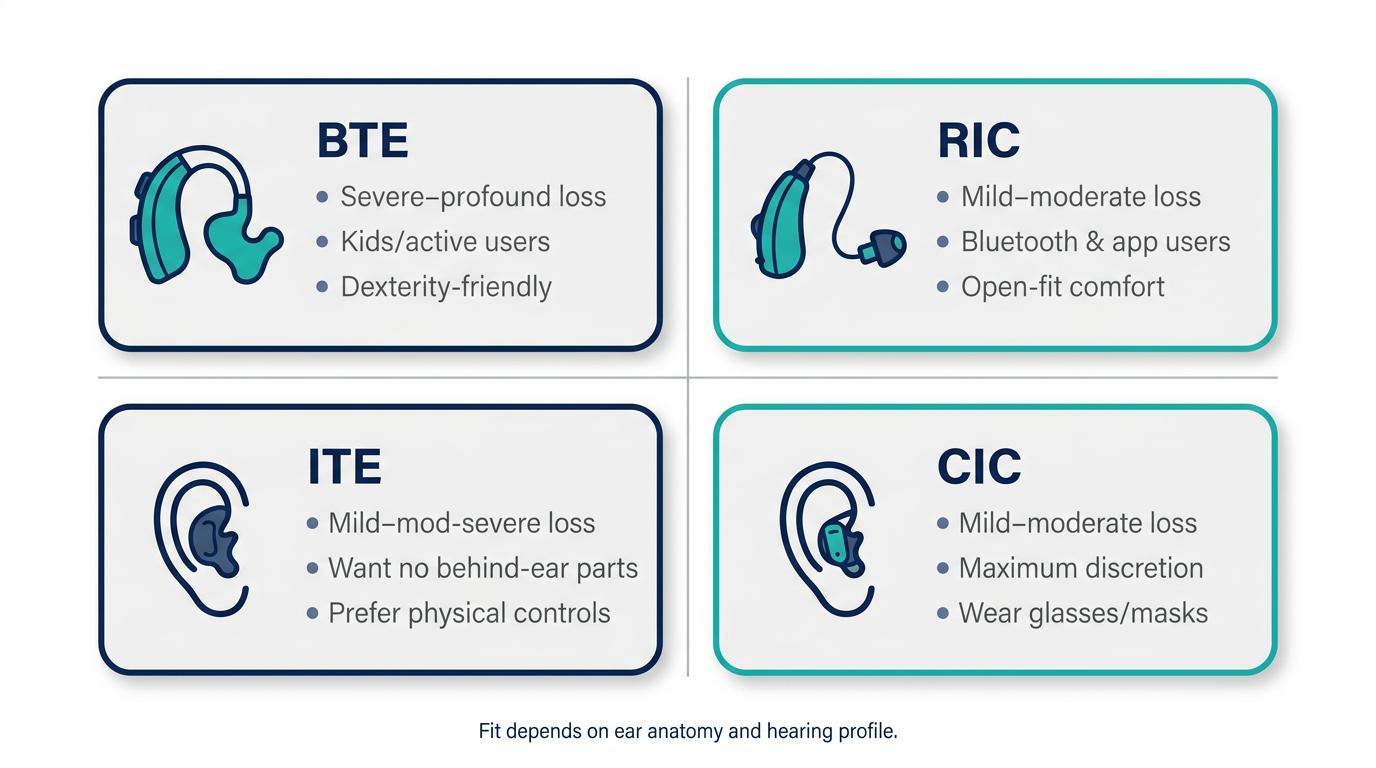
5. How to Choose the Right Hearing Aid Type
Selecting a suitable hearing aid involves more than comparing appearance or amplification power. Users should consider their hearing test results, daily environments, comfort requirements, and ability to operate the device.
Here are several important factors to consider:
Hearing Loss Severity
Different devices support different amplification requirements. BTE and higher-power RIC models may be appropriate for users with more significant hearing loss, while ITE and CIC devices are often considered for mild to moderate conditions.
Daily Listening Environments
People who frequently communicate in restaurants, workplaces, shopping centers, or other noisy environments may benefit from hearing aids with directional microphones and advanced speech enhancement features.
Wearing Comfort and Appearance
Some users prioritize discreet designs, while others prefer larger devices with easier-to-operate controls. A suitable fit is important for long-term wearing comfort.
Battery Life and Maintenance
Battery capacity, charging options, earwax protection, and cleaning requirements can influence everyday convenience. Users should consider these factors before making a purchase.
Professional Hearing Assessment
A professional hearing evaluation helps identify the type and degree of hearing loss. Hearing care professionals can recommend suitable devices, adjust sound settings, and provide follow-up support.
Conclusion: Find the Hearing Aid That Matches Your Listening Needs
Different hearing aid types offer different advantages in terms of sound amplification, wearing comfort, appearance, and functionality.
BTE hearing aids provide flexible amplification options, ITE and CIC models focus on compact designs, and RIC hearing aids offer a balance between discreet styling and adaptable sound performance.
There is no single hearing aid type that is ideal for everyone. The best choice depends on individual hearing test results, ear anatomy, lifestyle, and personal preferences.
By understanding the differences between BTE, ITE, CIC, and RIC hearing aids, users can make better-informed decisions and find a device that supports clearer communication and a more comfortable listening experience.
Post time: 十-31-2026