
Choosing the right hearing aid involves more than considering its price, appearance, or amplification power. Different hearing aid styles use different sound transmission methods and structural designs, which can significantly influence listening comfort, speech clarity, and everyday usability.
While some hearing aids focus on maintaining a natural listening experience, others are designed to improve sound transmission for specific types of hearing impairment. Understanding these differences can help users identify a suitable hearing solution based on their hearing condition and lifestyle.
Among the available options, Open-Fit Hearing Aids, In-the-Ear (ITE) Hearing Aids, and Bone Conduction Hearing Aids each offer distinct advantages and limitations.
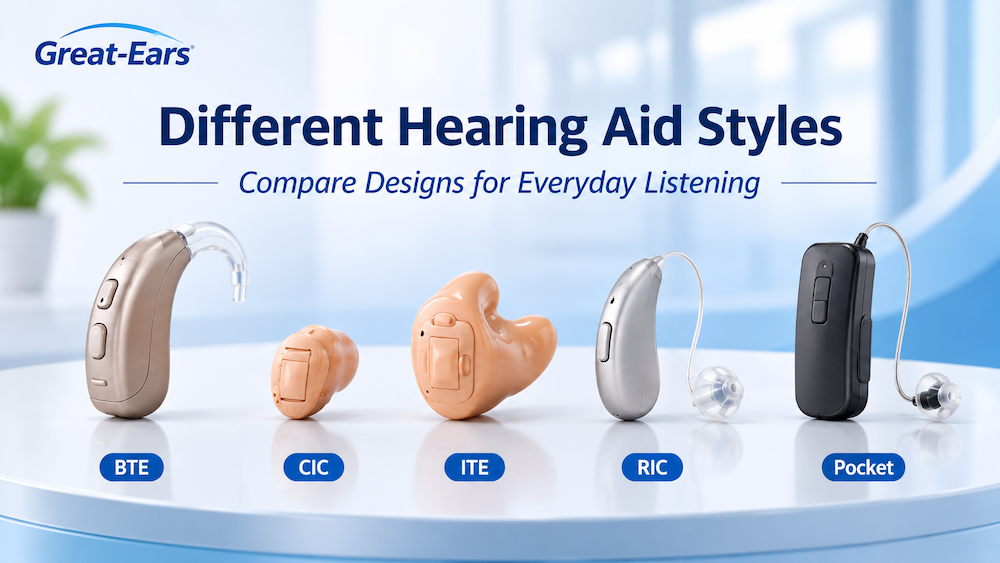
1. Open-Fit Hearing Aids: Natural Sound and Comfortable Listening
Open-fit hearing aids are designed to leave the ear canal partially open while delivering amplified sound through a small speaker or thin tube. This configuration allows natural environmental sounds to enter the ear while providing additional amplification where needed.
One of the biggest advantages of open-fit hearing aids is their comfortable wearing experience. Unlike traditional closed earmold designs, they reduce the blocked-ear sensation that some users experience when wearing hearing devices.
Key Advantages of Open-Fit Hearing Aids
- Natural Sound Experience: The partially open ear canal allows unamplified environmental sounds to enter naturally.
- Reduced Occlusion Effect: The open design can minimize the sensation of hearing one’s own voice inside the head.
- Lightweight Construction: Many open-fit models feature small, lightweight components for everyday comfort.
- Convenient Communication: They can provide useful amplification for people with suitable high-frequency hearing loss.
Open-fit hearing aids are generally suitable for individuals with mild to moderate high-frequency hearing loss, depending on their individual hearing profile.
However, their open configuration also creates certain limitations. Because amplified sound can escape through the open ear canal, these devices may not provide sufficient amplification for people with more significant hearing loss. Their ability to manage background noise also depends on microphone technology and digital signal processing.
2. In-the-Ear (ITE) Hearing Aids: Custom Fit and Direct Sound Delivery
In-the-Ear hearing aids are custom-designed devices that fit inside the outer ear. Their compact structure integrates the microphone, amplifier, receiver, and other electronic components into a single housing.
Because ITE devices are positioned within the ear, they can take advantage of the natural acoustic characteristics of the outer ear. This may help users perceive sound direction and environmental signals naturally, although actual performance varies by individual and device design.
Main Benefits of ITE Hearing Aids
- Custom-Molded Structure: Designed according to individual ear anatomy for a personalized fit.
- Convenient Operation: Larger ITE models may offer easier-to-use controls than smaller in-canal devices.
- Integrated Components: Electronic components are housed within one compact unit.
- Discreet Appearance: The device is less visible than many traditional behind-the-ear models.
ITE hearing aids can be suitable for people with mild to severe hearing loss, depending on the specific model and available amplification.
Despite these advantages, their position inside the ear makes them more exposed to earwax and moisture. Regular cleaning and maintenance are therefore important for maintaining stable performance.
Users should also consider ear anatomy, wearing comfort, and the physical dimensions of the selected model before purchasing an ITE device.
3. Bone Conduction Hearing Aids: An Alternative Sound Transmission Method
Bone conduction hearing aids work differently from conventional air-conduction hearing devices.
Instead of delivering amplified sound through the ear canal, they convert sound signals into mechanical vibrations that travel through the skull bones to stimulate the inner ear.
This technology provides an alternative listening pathway for people whose hearing difficulties are associated with problems in the outer or middle ear.
Advantages of Bone Conduction Hearing Aids
- Alternative Sound Transmission: Sound vibrations reach the inner ear through bone conduction.
- Useful for Conductive Hearing Loss: They may help individuals whose outer or middle ear conditions interfere with normal sound transmission.
- Potential Benefits for Single-Sided Deafness: Certain bone conduction systems can transmit sound from the affected side to the better-hearing ear.
- Reduced Dependence on the Ear Canal: Some designs do not require conventional ear-canal placement.
Bone conduction hearing aids are particularly relevant for people with conductive hearing loss, mixed hearing loss, or selected cases of single-sided deafness.
However, they are not suitable for every type of hearing impairment. Their effectiveness depends on inner-ear function, bone conduction thresholds, and the underlying hearing condition.
For typical age-related sensorineural hearing loss, conventional air-conduction hearing aids are often more appropriate. A professional hearing assessment is necessary to determine whether bone conduction technology is suitable.
4. Open-Fit vs ITE vs Bone Conduction Hearing Aids: Key Differences
Although all three hearing aid styles aim to improve hearing, their working principles and application scenarios are different.
The following comparison highlights their main characteristics.
| Comparison | Open-Fit | ITE | Bone Conduction |
|---|---|---|---|
| Wearing Position | Behind ear with open ear canal | Inside outer ear | On or near the skull |
| Sound Transmission | Air conduction | Air conduction | Bone conduction |
| Main Advantage | Natural listening and comfort | Custom fit and integrated design | Alternative sound transmission |
| Ear Canal | Partially open | Device occupies outer ear | Often does not require ear-canal placement |
| Typical Application | Suitable high-frequency hearing loss | Various hearing loss levels | Conductive loss and selected single-sided deafness cases |
| Maintenance | Regular cleaning | Earwax and moisture management | Depends on device design |
Actual performance varies according to individual hearing conditions, device specifications, fitting, and adjustment.
5. How to Choose the Right Hearing Aid Style for Everyday Use
Selecting an appropriate hearing aid requires understanding both hearing test results and daily listening requirements. A device that works well in a quiet home environment may perform differently in restaurants, workplaces, or outdoor public spaces.
Here are five important factors to consider.
5.1 Understand Your Hearing Loss Type
The first step is identifying whether hearing loss is conductive, sensorineural, or mixed.
Different hearing aid technologies are designed to address different hearing conditions. For example, open-fit devices are often considered for suitable high-frequency hearing loss, while bone conduction systems may be recommended for selected conductive hearing conditions.
5.2 Consider Your Daily Listening Environment
Think about where you spend most of your time.
People who frequently attend meetings, visit restaurants, or communicate in crowded environments may benefit from devices with directional microphones, speech enhancement, and digital noise management.
5.3 Prioritize Wearing Comfort
A hearing aid should fit comfortably without causing unnecessary pressure or irritation. Users should consider the device’s size, wearing position, ear anatomy, and daily wearing duration.
5.4 Evaluate Cleaning and Maintenance Requirements
Different hearing aid designs require different maintenance routines. Devices worn inside the ear may need more frequent earwax cleaning, while other styles may require attention to tubing, receivers, or external components.
Understanding maintenance requirements can help users maintain consistent device performance.
5.5 Seek Professional Fitting and Trial Experience
A hearing test provides important information about hearing thresholds and individual listening needs. Professional fitting helps ensure that amplification levels and sound settings are appropriate.
Whenever available, a trial period can also help users evaluate comfort, speech understanding, and everyday usability before making a final decision.
Conclusion: The Right Hearing Aid Depends on Individual Listening Needs
Different hearing aid styles provide different solutions for everyday listening challenges.
Open-fit hearing aids emphasize comfortable wearing and natural sound perception. ITE hearing aids combine custom fitting with an integrated design, while bone conduction hearing aids provide an alternative sound transmission method for selected hearing conditions.
There is no universally suitable hearing aid for everyone. The most appropriate option depends on hearing loss type, severity, ear anatomy, lifestyle, and personal preferences.
By understanding the differences between these hearing aid styles and seeking professional hearing assessments, users can make more informed decisions and find a hearing solution that supports comfortable listening and clearer communication.
Post time: Nov-13-2026