
As the global elderly population continues to grow, age-related hearing loss has become an increasingly important healthcare concern. Many seniors experience difficulties in conversations, social activities, and daily communication due to reduced hearing ability.
Although digital hearing aids have become popular because of advanced technologies such as artificial intelligence, Bluetooth connectivity, and automatic noise adjustment, Analog Hearing Aids for Seniors still remain a practical choice for many elderly users.
With simple operation, stable sound amplification, affordable pricing, and reliable performance, analog hearing aids continue to support seniors who prefer traditional hearing solutions without complicated smart functions.
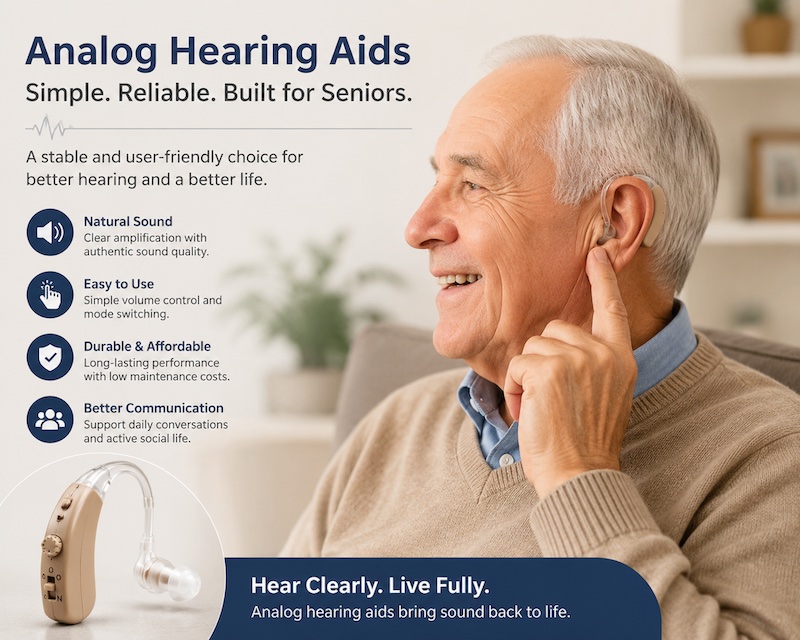
What Are Analog Hearing Aids for Seniors?
Analog hearing aids are traditional hearing devices that amplify surrounding sounds through basic electronic circuits. Unlike digital hearing aids that convert sound signals into digital data and process them through advanced algorithms, analog hearing aids directly increase the volume of incoming sounds.
The basic working process of Analog Hearing Aids for Seniors includes:
- The microphone captures surrounding sounds.
- The amplifier increases sound intensity.
- The receiver delivers amplified sound into the user’s ear.
This simple signal processing method allows analog hearing aids to provide continuous and natural sound amplification.
For many elderly users, especially those with mild to moderate hearing loss, this straightforward technology can effectively improve communication and daily listening experiences.
Benefits of Analog Hearing Aids for Seniors
Simple Operation for Elderly Users
One of the biggest advantages of Analog Hearing Aids for Seniors is their user-friendly design.
Many elderly people are not familiar with modern smart devices that require:
- Smartphone applications
- Bluetooth connections
- Digital programming
- Software updates
Analog hearing aids usually feature simple manual controls, including:
- Volume adjustment wheels
- Basic power switches
- Easy operation buttons
These simple functions allow seniors to adjust their hearing devices independently without depending on family members or professional technicians.
For elderly users who value convenience, simple operation can significantly improve confidence and daily usability.
Natural Sound Quality Without Complex Processing
Sound quality is one of the key reasons why many seniors continue choosing analog hearing devices.
Digital hearing aids often use advanced processing technology to reduce background noise and improve speech recognition. However, some users may feel that heavily processed sound is different from natural hearing.
Analog hearing aids amplify sound directly, maintaining the original characteristics of surrounding audio.
The benefits include:
- Natural voice reproduction
- Stable sound output
- Familiar listening experience
- Less complicated sound adjustment
For seniors who prefer traditional audio performance, analog technology provides comfortable and consistent hearing support.
Affordable Hearing Solution for Seniors
Cost is an important factor when selecting hearing equipment.
Compared with many advanced digital hearing aids, Analog Hearing Aids for Seniors are usually more affordable because they have simpler electronic structures and fewer complex components.
Main cost advantages include:
- Lower purchase cost
- Reduced maintenance expenses
- Easier repairs
- Longer service life
For families looking for cost-effective hearing assistance, analog hearing aids provide reliable performance without unnecessary additional functions.
Why Seniors Still Choose Analog Hearing Aids
Although the hearing aid industry is moving toward intelligent and digital solutions, analog hearing aids continue to maintain stable demand among elderly users.
Many seniors do not need advanced features such as:
- Wireless connectivity
- Mobile applications
- Automatic environmental adjustment
- AI-based sound optimization
Instead, their primary needs are simple:
- Hearing family conversations clearly
- Communicating with friends
- Participating in social activities
- Improving daily independence
For these users, Analog Hearing Aids for Seniors provide an effective balance between functionality, simplicity, and affordability.
Analog Hearing Aids vs Digital Hearing Aids
Choosing between analog and digital hearing aids depends on individual hearing conditions, lifestyle requirements, and personal preferences.
| Comparison | Analog Hearing Aids | Digital Hearing Aids |
|---|---|---|
| Sound Processing | Continuous amplification | Digital signal processing |
| Operation | Manual adjustment | Automatic adjustment |
| User Experience | Simple and natural | Customized and intelligent |
| Price | More affordable | Usually higher |
| Maintenance | Easier | More complex |
| Suitable Users | Seniors needing basic hearing support | Users needing advanced features |
Both technologies have their own advantages. The right choice depends on the user’s hearing condition and expectations.
Role of Analog Hearing Aids in Elderly Hearing Care
Hearing loss can affect more than just the ability to hear sounds. Many seniors with untreated hearing problems may experience:
- Reduced communication with family
- Less participation in social activities
- Lower confidence
- Increased dependence on caregivers
By improving sound awareness and communication ability, Analog Hearing Aids for Seniors help elderly users maintain active lifestyles.
They remain especially valuable in:
- Home healthcare
- Community elderly care
- Affordable hearing assistance programs
- Developing markets
How to Choose the Right Analog Hearing Aid for Seniors
Consider Hearing Loss Level
Analog hearing aids are generally suitable for seniors with mild to moderate hearing loss.
Before purchasing a hearing device, users should consider professional hearing evaluation to determine whether analog amplification meets their needs.
Choose Comfortable Hearing Device Designs
Comfort is essential because seniors may wear hearing aids for many hours every day.
Important factors include:
- Lightweight design
- Comfortable ear fitting
- Stable wearing experience
- Easy cleaning and maintenance
Select Easy-to-Use Controls
For elderly users, simple controls are often more valuable than complicated functions.
Good analog hearing aids should provide:
- Clear volume adjustment
- Easy power operation
- Simple daily maintenance
Pay Attention to Battery Life
Battery performance directly affects daily convenience.
A reliable hearing aid should provide:
- Long operating time
- Easy battery replacement
- Stable power supply
Future Development of Analog Hearing Aids
While digital hearing technology continues developing rapidly, analog hearing aids still maintain their own market position.
Future improvements may focus on:
- Smaller product designs
- Better sound amplification
- Improved battery efficiency
- Enhanced wearing comfort
Rather than completely disappearing, analog hearing technology will continue serving users who prioritize simplicity and reliability.
Conclusion: The Long-Term Value of Analog Hearing Aids for Seniors
Analog Hearing Aids for Seniors remain an important hearing solution because they provide simple operation, natural sound amplification, affordable pricing, and dependable performance.
For elderly users who prefer traditional technology and require basic hearing assistance, analog devices offer an effective way to improve communication and maintain social connections.
Although digital hearing aids provide more advanced features, analog hearing aids continue to play an important role in elderly hearing care by delivering practical and accessible hearing support.
Frequently Asked Questions About Analog Hearing Aids for Seniors
Are analog hearing aids suitable for elderly users?
Yes. Analog hearing aids are suitable for many seniors with mild to moderate hearing loss who need basic sound amplification and easy operation.
What are the advantages of analog hearing aids?
The main advantages include simple controls, natural sound output, affordable pricing, and reliable performance.
Do analog hearing aids need programming?
Most analog hearing aids do not require complicated programming. Users can adjust volume levels manually.
Are analog hearing aids cheaper than digital hearing aids?
Generally, analog hearing aids are more affordable because they use simpler electronic technology.
Who should use analog hearing aids?
Seniors who prefer easy operation, stable performance, and budget-friendly hearing solutions may consider analog hearing aids.
Post time: 八-07-2026